
Running a Martial Arts School Successfully
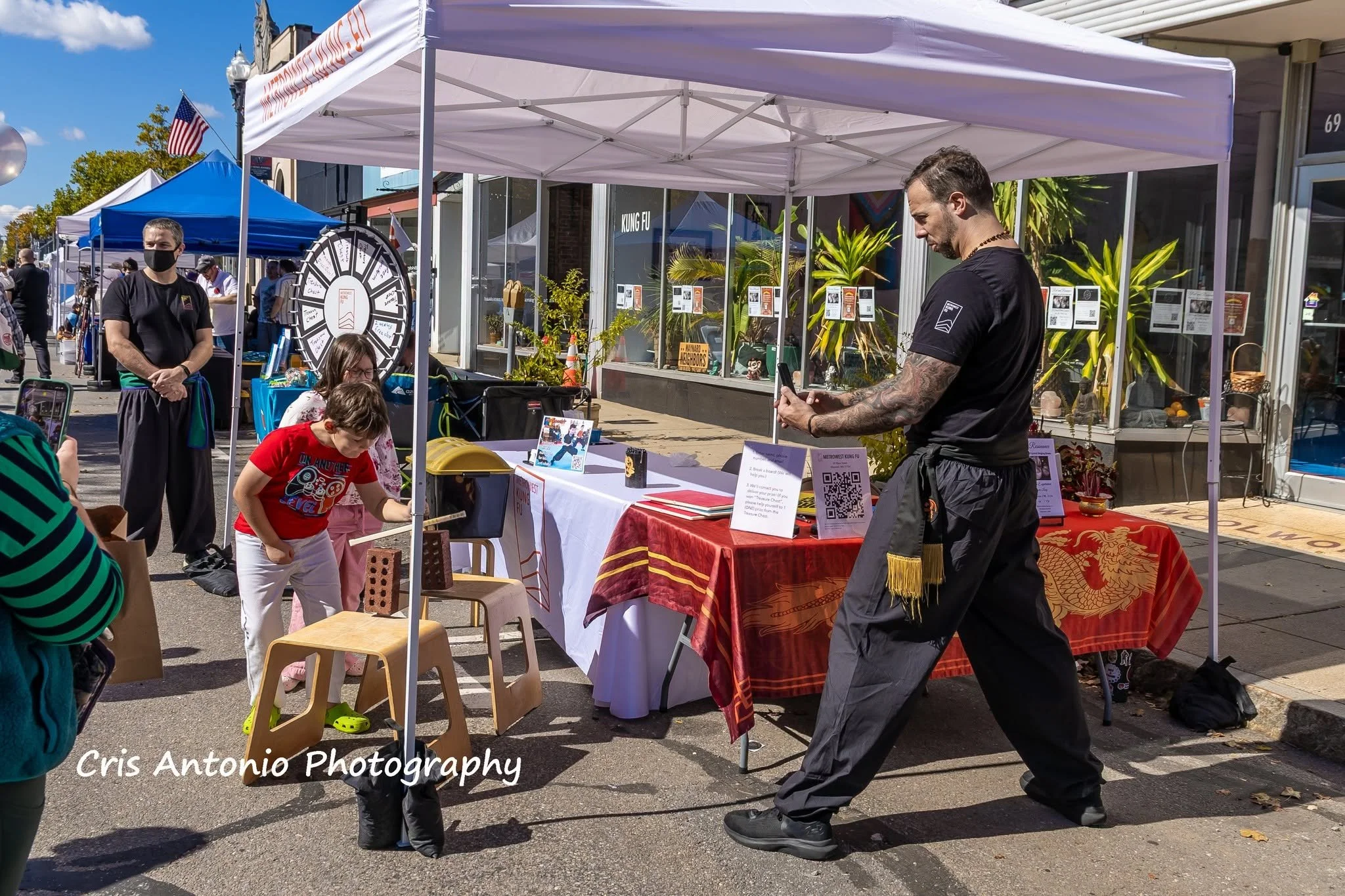
Me (right) and my student Ryan (left) hustling during Maynard Fest. I’m pretty sure I was fully dissociated by this point. Photo courtesy of Cris Antonio Photography.
I have been asked by many people how to run a school effectively. I’m not on the covers of magazines or anything but I have managed to make running a martial arts school my full-time job while building a beautiful community at the same time. Mostly through trial and error. So here are some thoughts in no particular order on how to help your school become successful.
First thing, being a good martial artist does NOT mean that
A, you’re a good teacher,
B, you’re a good business owner, or
C, you’re a good person.
You can have world championships under your belt or be a lineage holder from a famous teacher of a well-known style, that is zero guarantee that your school will thrive. Or, you can be a charismatic, effective instructor with a strong lineage, but if you use your student body as a dating pool (especially as a man), or if you injure your students while training, you will not be able to establish a strong nucleus of community - you may have a core group of students but it will be dysfunctional and possibly toxic.
Martial arts teachers sometimes get a distorted sense of reality over time, because people come to us without knowing a thing about us, and imbue us with wisdom and powers we absolutely don’t have. How many times have you had students ask you totally out-of-pocket questions about stuff like nutrition, religion, therapy, etc.? How many teachers do you know who too willingly impart sagely advice about topics they know absolutely jack shit about?
We also spend most of our time around other people who have both feet planted in this strange subculture, so it is easy for us to forget that for “normies” who might be interested in martial arts classes, lineage and credentials mean nothing. (Staying grounded in reality as a full-time martial artist is another topic I’d like to tackle sometime.)
So, what do you do to pull people into your school, then?
In my experience there are three main areas on which you should focus. In order of importance:
I. The people you want as students. In business terminology, the target demographic of your target geographic area.
II. Other businesses. In business terminology, business to business (B2B) networking.
III. Other martial arts schools. Similar to “other businesses” above but with some martial arts specificities.
Importantly, these three areas are interconnected.
First, you need to figure out who exactly you want as a student; this is part of the larger project of figuring out your business identity and target market. So before before I get into how to approach the three areas I listed above, I strongly recommend that you do two things:
Read “Starting and Running Your Own Martial Arts School” by Karen Levitz Vactor and Dr. Susan Lynn Peterson. It is an indispensable resource: https://bookshop.org/p/books/starting-and-running-your-own-martial-arts-school-karen-levitz-vactor/8b8ef941ef831bbf
Write a business plan. Here are a couple resources:
The short version is that you need to have a lot of stuff set up before you even start running classes. You need to have an internally consistent marketing package. You need to know what your target area is (where you are trying to draw your customers from geographically), and your target market. (Kids, young families, seniors, etc.) The resources I listed above can help you hammer all this out in detail. Once you have a strong sense of what your identity is in regards to your school, you can tackle the next three parts:
I. YOUR TARGET DEMOGRAPHIC (Who are your students?)
When you have your business plan written, you know who and where your target market is, and you are ready to start advertising, how you advertise is going to depend largely on where you are physically located, and who you are trying to reach.
People are going to find your school in a couple of different ways:
Online searches
Social media
Walk/Drive-by traffic
Word of mouth
Community events
Newspaper/magazine/mail ads
There are others but in my experience that is the bulk of “contact points”. You can’t do all of them, it is too much. So which one you lean into depends on other aspects of your business plan, such as your location, target demographic, etc. For example if your school is rural or “off the beaten path” you shouldn’t be relying on walk/drive-by traffic. Or, if your main target demographic is senior citizens for Tai Chi, then advertising in the local newspaper might make more sense than using social media or online ads.
I’ll cover each point of contact briefly.
Online Searches
In my opinion, this is crucial in this day and age. It’s also difficult and time-consuming. But, if you do not have good street presence or are not particularly well-connected to the local community, it will be absolutely necessary. The good news is that unlike print ads (see below), online ad services like Google and Facebook will allow you to set a budget, for example, $5/day. Some of the companies will even have a rep walk you through “optimizing” your ad performance on the phone. How to create and sustain ad campaigns is beyond the scope of this little essay, unfortunately. You can literally get a degree in setting up ad campaigns and running analytics, so my suggestion is to utilize the help that the companies are willing to offer.
Social Media
Social media is controversial - with the deleterious effects it’s had on peoples’ mental health, it’s becoming more common for people to have no social media account, or to engage in “posting zero” which means watching others’ social media accounts but not posting updates of their own. Oftentimes higher engagement on social media means engagement with other “professional” accounts or pages - frankly it feels to me like a lot of us business owners are creating content for each other to watch, rather than prospective students. How much time (if any) you choose to pour into this is a personal decision.
On paying for followers: I NEVER buy followers. Yes paying some money might bet you 10,000 likes from a click farm in India, but when your furnace explodes, those “likes” don’t translate into people in your community or organic connections you’ve built in real life, who may be willing to step up and help you out. Connections to followers on social media should be organic and if possible, based on real-life interactions. Furthermore, respect is a two-way street. You should be “liking” and engaging with other peoples’ content if you expect them to return the favor to you.
Walk/Drive By Traffic
This is how you grab people’s interest who are walking or driving by your school. If your school is in a high-traffic, downtown type of area, your street presence is going to be a lot more important than someone who has a school somewhere rural. If you have good street visibility, you want to invest a lot of time and energy into the outward appearance of your school, because first impressions are important. (Even if you’re off the beaten path, the outside of your school is going to be the first thing a student sees when approaching, and you want that impression to be positive.) Having a clean and well-kept exterior also helps your relationship with your neighbors, whether they’re businesses or residents. If the outside of your building is dirty, overgrown, etc., you could end up with your neighbors resenting you. Be a team player; for example, while I’m in a busy downtown area, that part of the street is quite dark at night, so I try to “light it up” a little bit by putting colored lights in the windows and making the space feel a bit more friendly.
If you’re in a high visibility area, other business owners may ask you to hang flyers and such in your window. I’m usually agreeable to this as it helps to foster a sense of community - if I offer this favor to other people, hopefully they will do it for me too when it’s my turn to advertise my business or a specific event.
You can also do things that get people to slow down and pay attention, like paint your windows in vivid colors, put dog treats out, etc.. (I put a basket of stickers outside for kids to take - in addition to being fun, it’s also a subtle way to indicate my politics and the “vibe” of my school - politics in martial arts schools is also a topic for another day.)
Word of Mouth
The best compliment a student can give you is a referral to another student. The good news is that you don’t have to do much for this - let the quality of your work speak for itself. (It goes both ways - you should also be open to criticism.) It doesn’t hurt to occasionally remind your students that you’re looking for new students constantly. You can also do a referral program. For example, if a student refers a new student, they get some kind of bonus or discount on their tuition. (But be careful not to let this go too far lest you veer into Ponzi scheme territory.)
Community Events
These are tough but crucial, and in my opinion, very necessary. The science on how many “impressions” a potential customer needs before spending money is still in flux - the conventional wisdom for many years was seven impressions from a business before a prospective customer spent money there. Unfortunately, social media has flipped that conventional wisdom on its head and people can’t seem to agree on how many “impressions” are needed to get a customer to spend money, or even if more impressions is necessarily a positive thing.
Personally, conventional business wisdom and social media aside, I think that putting yourself out there in the community is important. In addition to people seeing your face/brand/school in the “wild”, it’s also an opportunity for you to make a good first impression on them by being friendly, honest, etc.. It can also be an important opportunity for networking with other businesses and people in the community. I say these are “tough” because they often pull you away from your paying students and your regular classes, and they are often exhausting - requiring hours of preparation and breakdown.
Even more frustratingly, at least for martial arts schools whose primary product isn’t merchandise, the return on investment can be slow and difficult to track. Even so, I participate in these events as often as I can and adjust my strategy for each new event based on how the last one felt.
Newspaper/Magazine/Direct Mailing
I clump these altogether because frankly I don’t find the juice worth the squeeze. They’re quite expensive and while I do think that having an impression on a person (especially an older person) in print conveys financial success and stability from a business, in my opinion the cost-benefit analysis doesn’t work out. You can’t track how many people actually pay attention to your ads. How often do you look at all the ads in the local newspaper? If you’re like me, it’s straight to the recycling bin and I think that’s true of most people in my target market. I’m just not willing to spend hundreds of dollars per month on ads that people toss in the trash without even reading.
II. OTHER BUSINESSES & COMMUNITY ORGS
Especially in the early stages of your school, other local business owners will be crucial to your success. Not only can they refer their own customers to you, their endorsement can lend you credibility in the community. Groups that do B2B (business to business) networking are a really good opportunity to build connections in the community, and also to connect with a variety of resources you might not even be aware are available to you.
As an example I went to a chamber of commerce event, talked to a lady who was there representing the local senior center, and ended up signing up to teach Tai Chi classes to senior citizens there.
In my opinion the membership costs for these types of business alliances are low, while the return on investment is pretty high. I suggest checking out the local Chamber of Commerce or Business Alliance. (I have never been to a BNI meeting though people I know have suggested it.) Similar to social media, it requires investment on your part. You can’t just sign up for a membership and expect success, you have to show up at their events and do your part to uplift the other businesses there as well.
It’s also important to connect to “special interest” groups in the community. For example if you’re Chinese, it’s super important to connect to local Chinese-American civic groups. If you’re a queer person it’s very good to connect to local queer organizations. Even if you’re a boring white cis person, it is okay to attach yourself to groups or initiatives you believe in or care about. If Boy Scouts were important to you growing up, by all means, strike up a relationship with the local troop. If you’re religious, perhaps see if you can run a class or event at a local church, synagogue, mosque, etc..
III. OTHER MARTIAL ARTS SCHOOLS
Some martial arts school owners get weird and competitive with others, but in my experience, if you’re willing to put a friendly foot forward, people generally respond well to that. At the end of the day we are doing this because we believe that the martial arts help people, and we want more people in our communities to be doing martial arts. Especially Kung Fu, which has suffered a crisis of legitimacy in recent decades.
I try not to get defensive about other schools opening near me. Yes it can be a bit alarming when a competing school opens near you, but other teachers have different teaching styles and business models. If they’re a better fit for a prospective student, I’d rather have that person doing martial arts with someone else, than not at all.
That said, I have always jumped at chances to collaborate with teachers; not just via tournaments and seminars, but also through cooperative organizations like the New England Martial Arts Instructors (started by Master Robert Whitman and Sensei Lauren Cloutier) or the New England Tai Chi Alliance (started by Jon Woodward, unfortunately inactive since the pandemic.) These groups can be incredible resources for brainstorming ideas, sharing drills and techniques with each other, and for navigating the complex issues that arise while doing this particularly strange job.
This is only the tip of the iceberg. In addition to “Starting and Running Your Own Martial Arts School”, there are plenty of other great resources for martial arts teachers, which will help you address not just the economic side of things, but developing a healthy environment in your school.
“Fear is the Mind Killer: How to Build a Training Culture that Fosters Strength and Resilience” by Kajetan Sadowski: More about training self-defense safely and responsibly but with lots of good stuff about building a healthy school culture.
“I Am A Shifu: A Guidebook to Being a Successful Shifu” by Sifu Raul Ortiz: Very short and self-published, but with some helpful insight on student/teacher relationships in the Chinese martial arts.
There are certainly more and I think I will add to this list once I’ve read the stack of books I ordered on this specific topic, but my reading list is already comically large.
Thank you for reading and please feel free to hit me up with any questions or suggestions!
~ Shifu Eliot