
Holy cow, my nervous system has still not recovered from the Chinese Martial Arts Autumn Invitational, which was a lot of fun (and deserving of its own post which I’ll make later), but damn, the two weeks leading up to it were downright hellish. Just nonstop work, to the point where I had to cancel my classes the Thursday before in order to make sure everything was adequately prepared for Sunday.
There’s a lot to unpack with the tournament. Tournaments sharpen the contradictions of martial arts - high highs and low lows, and I want to go into both, because I don’t do bullshit and that includes my own; I want to be in the habit of looking unflinchingly at my own failings. Not to say the tournament was a failure, but as the kids say, there’s a lot to unpack.
BUT FIRST, I want to post scores, send out the competitor survey, and follow up with school owners and staff first. SO IN THE INTERIM. Here’s something I’ve been thinking about lately.
I’m sure that whether you’re a student or an instructor, you’ve run into that classmate/student who asks questions a lot in class, in a way that is not necessarily productive; he (because it’s almost always a “he”) is not REALLY asking for the sake of seeking knowledge or clarification. The “question”, rather, is a poorly-disguised attempt at signaling, either to the teacher or his classmates, his knowledge, expertise, or insight on the topic at hand. (And, we’re lucky if this unbidden gem of wisdom is actually on-topic.)
This is something kids do a lot. I’ll say something like “does anyone have any questions about horse stance,” a bunch of hands will shoot up, shoulders straining and teeth grimaced. I’ll say “Yes?” and then will hear “I GOT TO RIDE A HORSE ON MY FOURTH BIRTHDAY.”
Yes it’s cute, though less so when you’re already struggling to organize a group of extremely energetic, neurodivergent people for whom boundaries exist only on paper. Back when I first opened my school, my Sifu told me that the kids aren’t TRYING to derail the conversation and they’re not being selfish. He said, “They are trying to connect to you.”
He advised that I set aside specific times in the class (even if only before and after) where the kids have a chance to share something with me. It might have to do with their training or, more likely, it’s totally out of left field. 9 times out of 10 the kids will forget what they even wanted to say to you, but they won’t forget that an important adult in their lives took the time to let them know they were important by hearing what they had to say.
I think that this urge to be heard and feel acknowledged by the teacher comes from the same place when adults do it, but frankly, it’s a lot less endearing because there is a lot more baggage attached to an adult trying to get attention than a kid. At the end of the day, for an adult, it’s insecurity and a need for external validation.
I’m not unsympathetic to this, I get it. I’m a bisexual dude who was lying to myself about my sexuality until I was well into adulthood. I get the aching need to project normality and competency and confidence, because God forbid anyone sees what’s UNDERNEATH that facade. God forbid I see it.
So, I have some sympathy for these people, but also, you’re disrupting the class, and other people are there to learn martial arts, not to hold space for your lack of self-awareness. SO, here is a brief guide to asking questions in a martial arts class.
Is your question actually a question?
Can you answer it by watching your classmates?
Can you answer it by asking your classmates?
Can you answer it by watching your teacher?
Ask the teacher.
I MADE YOU A DIAGRAM. LOOK.
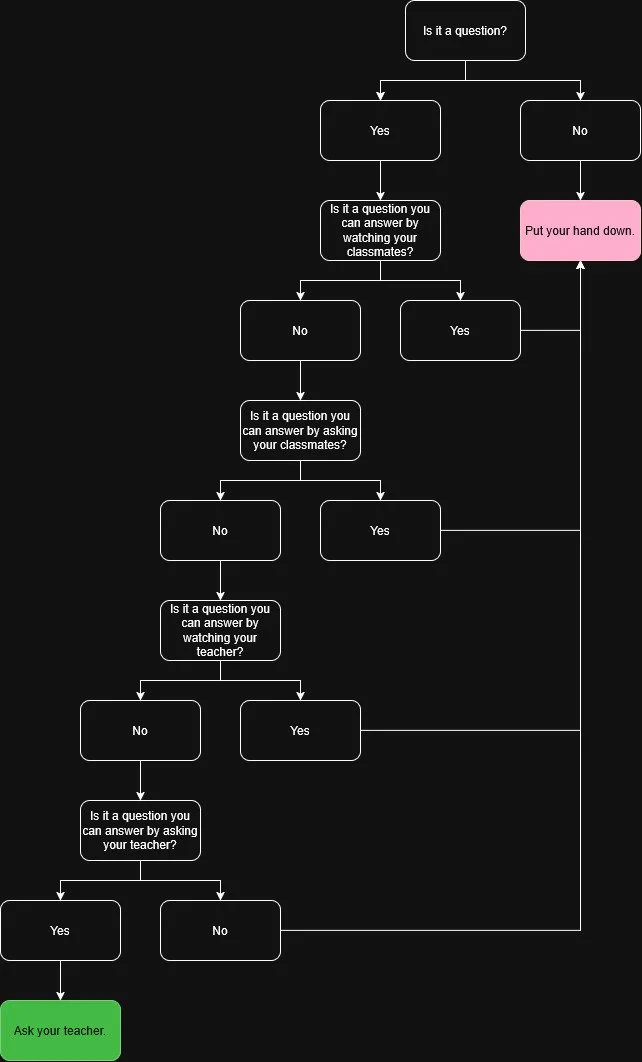
Yes obviously I’m being a bit snarky here. But what I’m trying to encourage is a bit of introspection about your line of questioning, and God forbid, curiosity about where your own thoughts are coming from, and why you feel the urge to say the things that you do.
I catch myself wanting to be the expert often, because I DO know some stuff about some things, but I try to run through this schematic in my head before I interject into the conversation, and hopefully this saves my classmates the emotional labor of being my unpaid therapists.
The idea more broadly here, is not to save the classmates and teacher emotional labor (though that is an added benefit.) It is more that this line of questioning (or non-questioning) is designed to guide how a student thinks about their training, and the ways in which they seek knowledge. I’d like to think that this sort of pedagogy guides a student into being an active learner, constantly seeking new information and sharpening their growing edge. This is the kind of thing that people are describing when they say their martial arts training helped them in other areas of their lives, and I think that is why most of us do this.
~ Shifu Eliot